
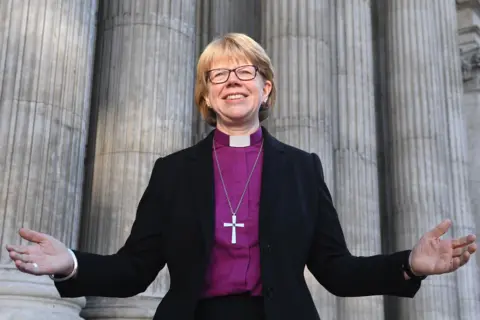
Dame Sarah Mullally has been appointed as the new Archbishop of Canterbury designate - making history as the first woman to be picked for this significant position.
Previously England's chief nursing officer, the 63-year-old became a priest in 2006 and was named as the initial woman to serve as Bishop of London in 2018 - occupying the third highest position of clergy in the Anglican Church.
This represents the initial occasion in almost five centuries of tradition that the Church has nominated a woman to assume its leadership.
Groundbreaking Selection
The Church has been without someone in the leading position for approximately twelve months after the previous Archbishop resigned over a safeguarding scandal.
He stepped down following a damning report into a prolific child abuser linked to the Church. The report found that he "could and should" have notified authorities about the misconduct by John Smyth of male youths to law enforcement in 2013.
Archbishop of York Stephen Cottrell took on most of the former Archbishop's responsibilities in an temporary arrangement, and was one of the voting members of the body tasked with selecting his successor.
Official Process
Following established custom, the procedure of choosing a spiritual leader involves a candidate being presented to Prime Minister Sir Keir Starmer and then forwarded to the sovereign.
The Prime Minister has applauded Dame Sarah's appointment, saying: "This position will serve an important function in our country's affairs. I wish her every success and look forward to collaborating."
While, technically, the monarch is leader of the Anglican Church, the person holding the position of spiritual leader is the highest-ranking cleric and is the religious guide of the Church and the global Anglican community.
Monarchical and International Response
The monarch has congratulated the new Archbishop on her new role, "which is of such importance in the United Kingdom and across the worldwide Anglican community", the royal household stated.
The Global Fellowship of Confessing Anglicans, which represents conservative views, has criticised the appointment, stating that although certain groups support the decision, "the majority of the global church still maintains that the Bible requires a male-only episcopacy."
Transition Period
She does not legally take on her new role until a formal approval process in the new year, and an installation ceremony comes later, after they have pledged allegiance to the monarch.
In a statement on the announcement day after her new role was finalized, she commented: "I recognize this is a significant undertaking but I undertake it with a sense of peace and trust in God to carry me as He always has."
Speaking from Canterbury Cathedral, she said that "in an age that craves certainty and group identity, the Anglican tradition offers something quieter but more resilient."
Responding to Attack
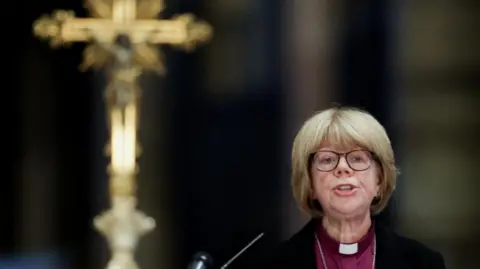
Addressing the "horrific violence" of the previous day's incident on a Jewish house of worship in Manchester, she stated "we are witnessing prejudice that rises up through fractures across our society."
She added: "The religious community have a responsibility to be a people who stand with the Jewish community against prejudice against Jews in all its forms. Hatred and racism of any kind cannot be allowed to divide our society."
Professional History
Married with two children, she devoted more than three decades in the NHS, achieving the position of the most junior person to serve as chief nurse for England in 1999.
While serving voluntarily in the Church at the period, it was just a short time after that she decided to become a clergy member and was quickly tasked with helping make reforms in the way the organization addressed abuse.
In that year she became financial administrator at Salisbury Cathedral before becoming Bishop of Crediton in the diocese of Exeter in 2015.
As Bishop of London she was seen as someone who used her experience as an NHS administrator to help modernise the church district.
Personal Philosophy
"I am often asked what it has been like to have had different professional paths, initially in the NHS and currently in the Church.
"I prefer to think that I have always had a single calling: to pursue Christian faith, to understand his teachings and to share his message, always seeking to live with compassion in the service of others, whether as a healthcare professional, a religious leader, or a church official."
Future Challenges
Possibly the most urgent thing in her in-tray is still to develop improved approaches towards addressing abuse and approaching with greater empathy those impacted by such incidents.
There has also been a decline in religious participation, though London has to some extent resisted this pattern.
A particular subject she has been particularly vocal on is end-of-life choices - she is a vociferous opponent, as was her predecessor.
When legislation was approved in the Commons, she described it as "impractical and dangerous and creates danger to the most at-risk individuals in our society."
Modern Positions
One of her roles as Bishop of London was to lead a committee trying to steer the religious institution's determination on whether to bless same-sex marriages.
She described the decision to finally allow clergy to sanction gay relationships in last year as "an optimistic development for the Church."
Rowan Williams, described her position as necessitating a "newspaper in one hand and a understanding of scripture."
Dr Williams told journalists "the pressure of having an position on all matters is significantly demanding."


